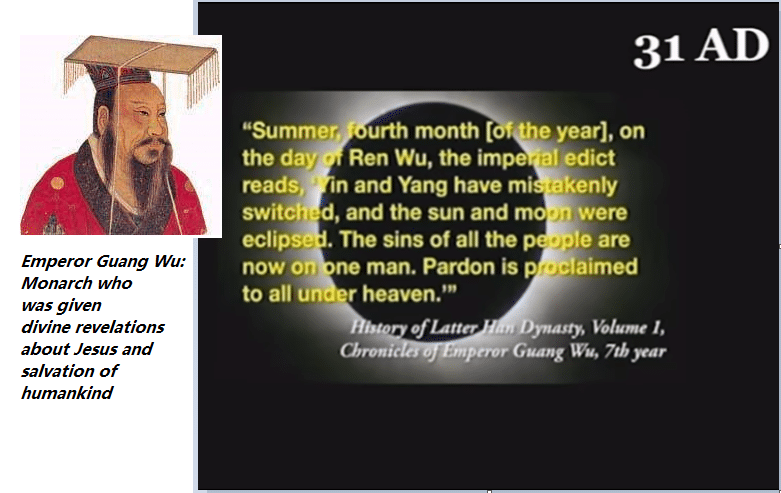
Emperor Guangwu was a good Chinese monarch who given divine revelations about Jesus and the salvation of humankind. Based on the Chinese history records about Emperor Guangwu, it is apparent that he is a significant figure, particularly during the Latter Han Dynasty. Historians regard him highly for his achievements in consolidating and ruling over a unified China by the time of his death in 57 AD. Here are some characteristics that suggest he was a good king:
- Unity and Consolidation: Emperor Guangwu is credited with consolidating various parts of China into a peaceful unified empire during his reign. This achievement places him among notable monarchs of his time who ruled vast territories, akin to figures like Augustus Caesar.
- Stewardship of the Empire: His reign marked stability and effective governance, which were crucial for the prosperity of the empire. He managed to bring stability after a period of turmoil following the collapse of the Qin Dynasty.
- Respect for Tradition: The articles highlight his respect for traditional Chinese religious practices, such as the annual sacrifices to Shangdi. This shows his reverence for cultural and spiritual traditions that were important to his people.
- Interest in Astronomy and Knowledge: Emperor Guangwu’s reign was also noted for advancements in astronomy, as evidenced by meticulous records of celestial phenomena like comets. This interest in knowledge and science suggests a broader perspective and intellectual curiosity.
- Legacy of Cultural Exchange: He presided over a period of cultural exchange, including interactions with neighboring regions and possibly exposure to foreign religions and ideas. This openness could have contributed to a more diverse and enriched cultural landscape.
In summary, Emperor Guangwu appears to have been a competent ruler who prioritized unity, stability, cultural tradition, and intellectual pursuits. His reign left a significant mark on Chinese history, influencing the trajectory of the Han Dynasty and shaping the cultural and political landscape of ancient China. More importantly, this good Emperor was graced by God, and given divine revelations about Jesus and the salvation of humankind. (Read more here: Ancient Chinese Records About Jesus’ Death and Resurrection https://voanews.xyz/86-2/)
It should not come as a surprise to Bible believing Christians that God would choose to give such an important revelation to a Chinese monarch, and yet could not get through to any Jewish monarchs of Jesus’ time. Since the beginning of the world, God has always endeavored to speak to humankind, even individually, but, whether or not they heard, depends on the condition of their hearts, whether or not, they are “good soil”, who obey the promptings of God’s Spirit. (cf. Matthew 13:23-33, Romans 2:12-16)
A case in point: let’s read Genesis 12 and 20, where we will observe two monarchs (Pharoah/King of Egypt and King of Gerar) to compare how God and they interacted, based on the conditions of their heart.Genesis 20 is deja vu of Genesis 12. Twice, famine made Abraham leave where he was originally located, to travel with his wife to a new place, seeking supplies for his household.
As was the case in Egypt, out of fear, Abraham for the second time, asked Sarah to say that she was his half-sister. It is true that they shared the same father, but have different mothers (Gen 20:12). But, God seemed to be silent verbally when the Pharaoh took Sarah (then Sarai) away from her husband. To stop Sarai’s wife from continuously being separated and violated, God had to send affliction to Pharaoh, and Pharaoh complained to Abram: Why didn’t you tell me that Sarai is your wife (Gen 12:17-20, cf. Gen 20:8-11).
Abimelech, King of Gerar, also took Sarah as his wife (Gen 20:2) for the same reason: because Abram didn’t dare admit that Sarai is his wife.
What was different in Abimelech’s case, was that there was no affliction of plagues, as in the household of Egypt. God verbally acknowledged the integrity of Abimelech’s heart, and therefore God did not let Abimelech touch Sarah, but appeared in a dream to warn him of his impending doom and destruction if he carried on his original plans. But, King Abimelech was told that Abraham the prophet can pray for Abimelech to reverse the impeding curse, if he quickly undo what he did wrong unintentionally. God even healed the wombs of the women in Abimelech’s household, giving them children that were withheld because of Sarah (v. 17). God speaks to all who are willing to give Him space to speak to them! (Gen 20:3-7)
About the Author

Welcome to Voices of Asia!
Subscribe to email postings of free articles.
Get news and exclusive promotions in your inbox too.
欢迎来到亚洲之声!
订阅电子邮件,免费获取精选文章。
您还可以在收件箱中收到最新资讯和独家优惠信息。
If you'd like to support this work financially, you can upgrade your membership to a higher tier and gain access to even more exclusive content. If interested, read more here:https://voanews.xyz/en/subscription-donation/
如果您希望为这项工作提供经济支持,您可以选择升级会员等级,以获取更多独家内容。 感兴趣的话,欢迎联络我们了解详情 :VoicesOfAsia333@gmail.com


 English
  Chinese