TThe Reign of Emperor Guangwu: A Pillar of the East
Emperor Guangwu, the founder of the Eastern Han Dynasty, ruled with profound wisdom from 25 to 57 AD. He restored peace and prosperity to China after a turbulent period of civil war, establishing what historians now call the Later Han Dynasty. By the time of his death in 57 AD, he had successfully consolidated the entire country—a monumental achievement that places him in the league of other great monarchs of his era, such as Augustus Caesar.
Guangwu was a significant and powerful ruler, not a minor king. His reign was marked by a commitment to restoring the spiritual and moral foundations of the empire. Notably, he reinstated the correct “Border Sacrifices” (郊祀, Jiaosi), where he abolished the cluttered and superstitious polytheistic practices—known as “excessive sacrifices” (淫祀)—that had emerged during the late Western Han and Wang Mang eras. By establishing the “Southern and Northern Suburb” ritual, he centralized the nation’s worship on Shang Di (the Supreme Emperor of Heaven), aligning the empire with the worship of the one true God.
While he was deeply influenced by the traditional Chinese worldview emphasizing the balance of Yin and Yang, his perspective shifted dramatically in the seventh year of his reign, around 31 AD. During this time, a supernatural celestial event—a solar eclipse that defied natural lunar patterns—led him to acknowledge a power far higher than his own. In a state of deep reverence, he ceased all military and official duties for five days, seeking the mercy of Heaven.
Beyond his religious reforms, Guangwu was an exceptionally benevolent leader who prioritized the welfare of his people after years of conflict. His ability to combine strong governance with a humble recognition of divine authority makes his reign a unique “legal witness” in history, specifically as his era coincided with the redemptive events taking place in Jerusalem.
光武帝的统治:东方之柱
光武帝是东汉王朝的开国皇帝,于公元 25 年至 57 年 间施行仁政。在经历了动荡的内战之后,他恢复了中国的和平与繁荣,建立了史称的“后汉”。到公元 57 年 驾崩时,他已统一全国;这一成就使他与同时代统治广阔帝国的君主(如奥古斯都·凯撒)并驾齐驱。
光武帝是一位举足轻重的统治者。他的统治以致力于恢复中国动荡后的属灵与道德根基而著称。他最显着的功绩之一是恢复了正统的“郊祀”制度;他废除了西汉末年及王莽时期兴起的繁杂且往往带有迷信色彩的“淫祀”(多神崇拜)。通过确立“南北郊”祭礼,他将国家的崇拜重心重新聚焦于皇天上帝。
虽然他深受强调阴阳平衡的传统华夏世界观影响,但在他统治的第七年(即公元 31 年左右),他的世界观发生了剧变。当时的一场超自然天象引导他承认了超越世俗权柄的神圣力量。
除了宗教改革,他更是一位极具智慧且仁慈的君主,在长年内战后为这片土地带来了和平与繁荣。他将强大的治理能力与对神圣权威的谦卑认可相结合,使他的统治成为历史上一个独特的“法律见证”,尤其是他的时代正值耶路撒冷发生救赎事件之际。
| Feature | Emperor Guangwu’s Reform (25–57 AD) | Biblical Principle / Scripture |
| Monotheism | Abolished “Excessive Sacrifices” (淫祀): He removed polytheistic and superstitious rituals to focus on one Supreme Power. | Repentance from Idols: “Turn to God from idols to serve the living and true God” (1 Thessalonians 1:9). |
| Object of Worship | Reinstated Border Sacrifices (郊祀): He centralized worship specifically toward Shang Di (皇天上帝), the Supreme Emperor of Heaven. | The One True God: “Now this is eternal life: that they know you, the only true God, and Jesus Christ” (John 17:3). |
| The Representative | The “One Man” Principle: In the 31 AD edict, he declared that the “sins of all are on one Man”. | The Great Substitute: “For as by one man’s disobedience many were made sinners, so by one man’s obedience many will be made righteous” (Romans 5:19). |
| Legal Amnesty | Universal Pardon: His response to the 31 AD eclipse was to proclaim “pardon to all under Heaven”. | The Gospel Proclamation: “Through Him everyone who believes is set free from every sin, a justification you were not able to obtain under the law of Moses” (Acts 13:39). |
| Humility in Power | Refused the title “Holy” (Sage): Following the eclipse, he forbade officials from calling him holy, acknowledging his lack of virtue. | Humility Before God: “God opposes the proud but shows favor to the humble” (James 4:6). |
| 特点 | 光武帝的改革 (西元 25–57 年) | 圣经原则 / 经文 |
| 独一真神观 | 废除“淫祀”: 他废除了多神崇拜和迷信仪式,转而专注于最高的主宰。 | 离弃偶像: “离弃偶像,归向神,要侍奉那又真又活的神。” (帖撒罗尼迦前书 1:9) |
| 崇拜对象 | 恢复“郊祀”: 他将祭祀重心重新聚焦于皇天上帝。 | 唯一的真神: “认识你名下的独一真神,并且认识你所差来的耶稣基督,这就是永生。” (约翰福音 17:3) |
| 代表性原则 | “在余一人”原则: 在西元 31 年的诏书中,他宣告“众位之罪,在余一人”。 | 伟大的代求者: “因一人的悖逆,众人成为罪人;照样,因一人的顺从,众人也就成为义了。” (罗马书 5:19) |
| 法律性大赦 | 普遍赦免: 他对西元 31 年日食的回应是宣告“大赦天下”。 | 福音的宣告: “你们靠摩西的律法,在一切不得称义的事上,信靠这人,就都得称义了。” (使徒行传 13:39) |
| 权柄下的谦卑 | 拒绝“圣”号: 日食后,他禁止百官称他为“圣”,承认自己德薄。 | 在神面前谦卑: “神阻挡骄傲的人,赐恩给谦卑的人。” (雅各书 4:6) |
The Solar Eclipse and the Crucifixion: A Legal Witness in the East
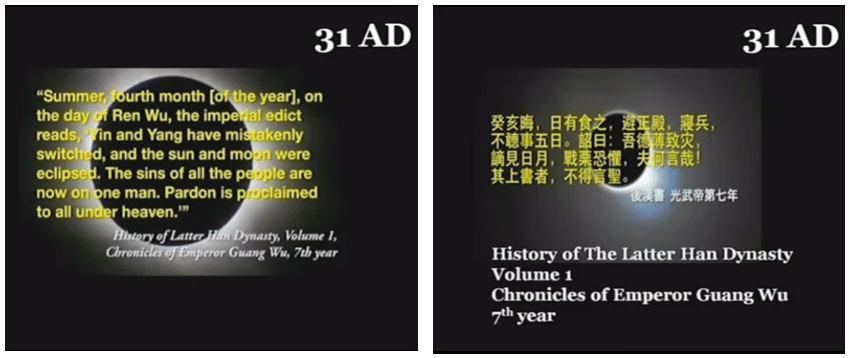
In 31 AD, the official Han Dynasty archives captured an event that shook the foundations of the empire. On the last day of the month—a timing that defied natural lunar patterns—a total solar eclipse occurred. Alarmed by this celestial anomaly, Emperor Guangwu ceased all military activities and official duties for five days, issuing a profound proclamation:
“Yin and yang have mistakenly switched, and the sun and moon were eclipsed. The sins of all the people are now on one Man; pardon is proclaimed to all under Heaven.”
(History of Latter Han Dynasty, Volume 1, Chronicles of Emperor Guang Wu, 7th Year)
The records further state: “Eclipse on the day of Gui Hai, Man from Heaven died” (History of Latter Han, Annals No. 18, Gui Hai).
The True “Man from Heaven”
While Chinese emperors were traditionally called the “Son of Heaven” (天子), the term “Man from Heaven” (天人) carries a distinct divine weight. Notably, Emperor Guangwu did not die during this event; he lived until 57 AD. He could not have been alluding to himself, as historical records show that during this 31 AD eclipse, he refused to be called “Holy” (Sage) and publicly confessed his own lack of virtue.
This humility proves that the Emperor recognized he was not the perfect “Man from Heaven”. In the framework of Cultural Archaeology, earthly kings served as a “shadow” or “preview” of the true King. The “Man from Heaven” mentioned in the Han archives refers to the Divine Redeemer who descended from above—Jesus Christ—whose death on the Cross at that exact moment provided the “Pardon for all under Heaven” recorded by the Chinese state.
日食与受难:东方史册中的法律见证
在公元 31 年,汉朝官方档案记录了一个震惊帝国的事件。在该月的最后一天(这违背了自然月相规律),发生了一场全日食。面对这一天象异变,汉光武帝停止了一切军事活动和五天的公务,并颁布了一份意义深远的诏书:
“阴阳错失,日月薄食。众位之罪,在余一人。大赦天下。”
——《后汉书·本纪第一·光武帝纪》
史料进一步记载:“癸亥日蚀,天人崩”(《后汉书·志第十八》)。
真正的“天人”
虽然中国皇帝传统上被称为“天子”,但“天人”一词带有独特的神圣维度。值得注意的是,光武帝本人并未在此时驾崩;他一直统治到公元 57 年。他绝非自指,因为史料记载,在公元 31 年面对日食时,他拒绝被称作“圣”(圣人),并公开承认自己德薄。
这种谦卑表明,他自认并非那位完美的“天人”。在“文化考古”的框架中,地上的君王只是那位真正君王的“影子”或“预演”。汉朝档案中所提到的“天人”,是指那位从天而降、拥有神性的救赎者——耶稣基督。正是基督在那一刻在十字架上的受难,成就了中国官方所记录的这份“大赦天下”。
A Divine Broadcast: Beyond Human Speed
This proclamation by Emperor Guangwu—declaring that the sins of all are on “one Man”—alludes to none other than Jesus Christ, whose crucifixion coincided with this documented eclipse. In an era where the fastest mode of land transport was by horse, and with the Han capital situated over 7,000 km away from Jerusalem, it would have been humanly impossible for the news of the trial and crucifixion of Jesus to reach China within days. The events in Judea escalated too rapidly for any physical messenger to bridge the distance.
While human messages spread slowly, God’s message travels from His throne room. On the Hebrew calendar, Nisan 14 marks the start of Passover—the day when lambs are slaughtered. It was on this very day that Jesus, the ultimate Sacrificial Lamb, was slain for the salvation of all who come under His protection. God chose to supernaturally “download” this revelation of salvation through Jesus directly to the monarch of China.
According to the Bible, following Jesus’ crucifixion at nine in the morning (Mark 15:25-33), Matthew 27:45 states that “darkness came over the whole land from noon until three in the afternoon.” In the Old Testament, such darkness is often associated with judgment (see Amos 5:18; 8:9). Jesus sacrificed Himself, taking our place and shedding His blood to atone for humanity’s sins, offering the gift of eternal life.
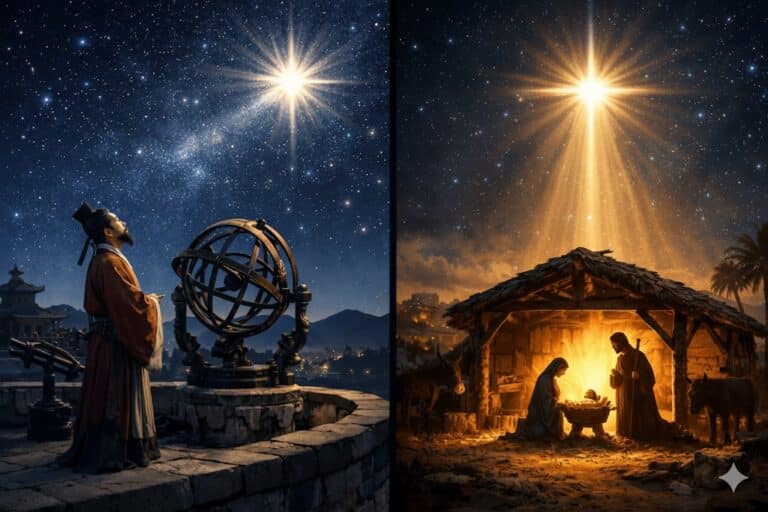
Should it be surprising that God communicates through the stars? When Jesus was born, angels brought the news to lowly shepherds, and wise men from the East—having been notified by a star long before the birth—traveled to visit the newborn King with special gifts (Matthew 2:1-12). God’s divine orchestration ensured that even in the distant East, the “Pardon for all under Heaven” was legally recorded and proclaimed.
神圣的宣告:超越人类的速度
光武帝这份宣告万民之罪尽归“一人”的诏书,指的正是耶稣基督,祂的受难与记录中的这场日食完全吻合。在那个陆地最快交通工具仅为马匹的时代,汉朝京城距离耶路撒冷超过 7000 公里;考虑到从审判到受难的过程极其迅速,人类信息不可能在数日内传达。从人的角度来看,消息的传播绝无可能如此之快。
当属世的消息缓慢传播时,上帝的信息直接从祂的宝座发出。在希伯来历中,尼散月 14 日标志着逾越节的开始,即宰杀羔羊的日子。正是在这一天,耶稣作为终极的代罪羔羊,为所有寻求祂庇护的人舍命救赎。上帝神圣地选择将这一通过耶稣得救的惊人启示,超自然地“下载”并启示给了中国的君王。
根据圣经记载,耶稣在早晨九点被钉十字架(马可福音 15:25-33),马太福音 27:45 记载道:“从正午到下午三点,遍地都黑暗了。”在旧约中,黑暗往往与审判联系在一起(参见阿摩司书 5:18; 8:9)。耶稣牺牲了自己,代替了我们的位置,流出宝血为人类赎罪,赐予我们永生的礼物。
上帝通过星辰传递信息,甚至进行直接沟通,这并不令人惊讶。当耶稣降生时,天使将好消息告诉了卑微的牧羊人;来自东方的智者也早在出生前就得到星象的启示,带着珍贵的礼物前来朝拜新王(马太福音 2:1-12)。上帝神圣的编排确保了即便在遥远的东方,“大赦天下”的消息也被正式记录并宣告。
About the Chinese Ancient Records that aligns with the Biblical record, read here: https://voanews.xyz/124-2/
The Legal Anomaly of “Bēng” (崩): A Cosmic Death Recorded
In the rigid hierarchy of imperial China, language was a matter of strict legal protocol. The word “Bēng” (崩)—meaning “to collapse” like a great mountain—was reserved exclusively for the death of a reigning Emperor. For a court historian to use this term while the current monarch, Emperor Guangwu, was still alive and healthy was a massive departure from standard record-keeping—it was a linguistic impossibility unless it referred to a being of even higher divine status. By recording “Man from Heaven died” (天人崩) in 31 AD, the Han archives acknowledge that the “collapse” occurring was not that of an earthly king, but of the very pillar of Heaven. This unique entry serves as an immutable legal witness: at the exact hour the sun went dark in the East, the true “Man from Heaven” surrendered His life in the West, shaking the foundations of both the physical and spiritual worlds.
“崩”之奇迹:史册中的超自然死亡
在等级森严的古代中国,语言的使用是严格的法律规范。“崩”字意为大山倒塌,在史册中专指在位皇帝的驾崩。对于史官而言,在光武帝依然在位且健康(光武帝于公元 57 年才驾崩)的情况下使用“崩”字,是极大的记录异常——除非其指向的是一位地位远超世俗帝王的神圣存在。通过在公元 31 年记下“天人崩”,汉朝档案承认了这场“崩塌”并非源于地上的王,而是上天的支柱。这一独特的记录成为了不可磨灭的法律见证:当日头在东方变黑的那个时刻,真正的“天人”在西方舍弃了生命,震撼了物质与属灵世界的根基。
Evidence Summary: The 31 AD Celestial Witness 证据摘要:西元 31 年的天象见证
Here is the “Legal Evidence Card” summarizing the three major anomalies found in the History of the Latter Han Dynasty that provide a global witness to the Crucifixion of Jesus Christ. 以下是《后汉书》中三个重大异常现象的“法律证据卡”,它们为耶稣基督的受难提供了全球性的见证。
| Evidence Point | Historical Record | The Supernatural & Legal Anomaly |
| The Impossible Date | Gui Hai (Last day of the month) | Solar eclipses are scientifically impossible on the last day of a lunar month; this records a supernatural darkness. |
| The “One Man” Edict | “The sins of all the people are now on one Man” | The Emperor utilized an ancient substitutionary code to explain the darkness, mirroring the “Sin-Bearer” theology of the Gospel. |
| The Misplaced “Bēng” | “Man from Heaven died” (Tiān Rén Bēng) | The term Bēng (Imperial Death) was used while Emperor Guangwu was alive, proving it recorded the death of a Divine Being. |
| The Divine Title | “Tiān Rén” vs. “Tiān Zǐ” | The records eschewed the standard title for a King (Tiān Zǐ) in favor of Tiān Rén (Man from Heaven), identifying a being of celestial origin. |
| 证据要点 | 史料记载 | 超自然与法律异常之处 |
| 不可能的日期 | 癸亥晦(该月最后一天) | 日食在月底最后一天在科学上是不可能的;这记录了一场超自然的黑暗。 |
| “余一人”诏书 | “众位之罪,在余一人” | 皇帝使用了古代的“代赎代码”,完美契合了福音中“背负罪孽者”的神学。 |
| 破格使用的“崩” | “天人崩” | 在光武帝在位且健康时使用了“崩”字,证明其记录的是一位神圣存在的死亡。 |
| 神圣的称谓 | “天人”与“天子”之别 | 史料摒弃了君王的正式称号(天子),改用“天人”,指明了一位拥有属天起源的存在。 |
Chronological Note: Why 31 AD?
Some readers may wonder why many scholars and theologians now point to 31 AD as the year of the Crucifixion, rather than the traditionally cited 33 AD. It is important to remember that terms like “BC” and “AD” are part of the Julian and Gregorian calendars and were not present in the original biblical texts.
By meticulously analyzing the internal evidence provided by the Bible writers—including the timing of the Passover, the length of Jesus’ ministry, and the prophetic “70 weeks” of Daniel—many researchers have concluded that 31 AD is the historically and biblically accurate year. This date provides a perfect alignment between the Hebrew calendar (Nisan 14) and the astronomical records found in ancient world histories, such as the Han Dynasty archives.
Recommended Resources for Further Study:
- The Practically Indisputable Case for 31 AD Crucifixion: An in-depth look at the Jubilee cycles and chronological evidence.
- Biblical Evidence For 31 AD Crucifixion: A breakdown of the scriptural clues pointing to this specific year.
- When Did Jesus Die?: A focus on the specific timing of Friday, April 27, 31 AD [Nisan 14] at 3 PM.
- The Hebrew Calendar’s Authority Proved: Proving the authority of the Hebrew calendar through the death and resurrection of Christ.
年代考据注:为什么是西元 31 年?
有些读者可能会好奇,为什么许多学者和神学家现在倾向于认为基督受难是在公元 31 年,而非传统所说的公元 33 年。我们需要记住,“公元前 (BC)”和“公元 (AD)”是儒略历和格里高利历的产物,圣经原著中并未包含这些术语。
通过对圣经作者提供的内部证据(包括逾越节的时机、耶稣传道的时间长度,以及但以理书中关于“七十个七”的预言)进行严谨分析,许多研究人员得出结论:公元 31 年在历史和圣经角度上更为准确。这一日期使希伯来历(尼散月 14 日)与世界古代史(如汉朝档案)中的天文记载达成了完美的契合。
View the articles and videos here: 推荐进一步阅读的资源:
1) The Practically Indisputable Case for 31 AD Crucifixion of Jesus 公元 31 年受难的无可争辩性:深入探讨禧年周期与年代学证据。https://bytemaster.medium.com/practically-indisputable-case-for-31-ad-jesus-crucifixion-and-2024-jubilee-968af9b51a30
2) Biblical Evidence For 31 AD Crucifixion 公元 31 年受难的圣经证据:详细解析指向该年份的圣经线索。 https://www.christianforums.com/threads/biblical-evidence-for-31-ad-crucifixion.8276242/
3) When did Jesus die? – Jesus died on Friday 31 AD April 27 at 3 pm [Nisan 14] 耶稣何时受难?:重点研究公元 31 年 4 月 27 日(尼散月 14 日)星期五下午 3 点这一具体时刻 https://www.godswordexplained.com/?page_id=715
4) The Hebrew Calendar’s Authority Proved! —By Christ’s Death and Resurrection 希伯来历的权威性证明:通过基督的死与复活论证希伯来历的权威性。https://pcg.church/articles/392/the-hebrew-calendar-s-authority-proved-by-christ-s-death-and-resurrection#:~:text=With%20this%2C%20and%20the%20Daniel,at%20Passover%20in%20a.d.%2031.
The Resurrection and the Rainbow Halo
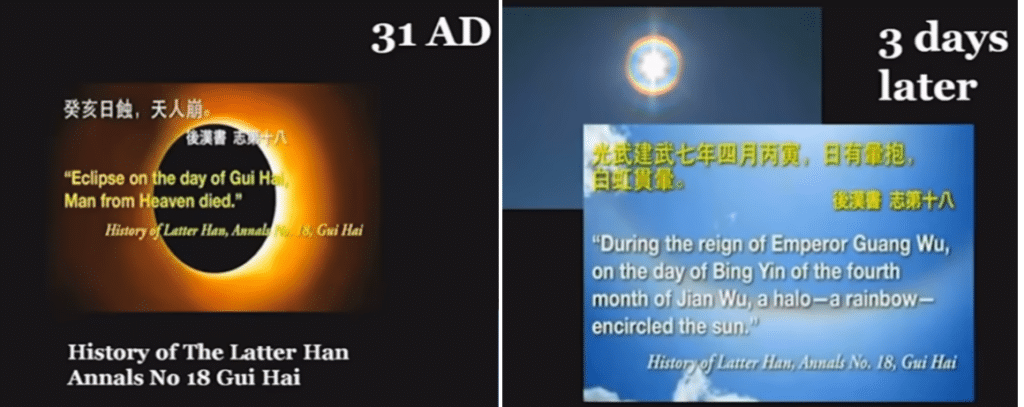
Three days after His crucifixion, Jesus rose from the dead, demonstrating His definitive victory over death and sin and confirming His divinity as the Son of God. Remarkably, ancient Chinese chronicles provide a celestial witness to this event. The records of the Eastern Han Dynasty describe a phenomenon that occurred exactly three days after the eclipse of 31 AD:
“During the reign of Emperor Guangwu, on the day of Bing Yin of the fourth month, a halo—a rainbow—encircled the sun.” > — History of the Latter Han, Annals No. 18, Gui Hai
This celestial sign aligns perfectly with the biblical timeline of the Resurrection. It suggests that Emperor Guangwu and his astronomers were given a prophetic revelation through the heavens, marking the moment the “Man from Heaven” overcame the darkness of the grave.
Celestial Signs and Their Interpretation
The rainbow encircling the sun serves as a divine confirmation of the New Covenant established through Christ’s victory. In the Bible, rainbows are powerful symbols of God’s faithfulness and promises:
- The Noahic Covenant: After the Great Flood, God placed a rainbow in the sky as a sign of His promise never to destroy the earth with water again (Genesis 9:13).
- The Heavenly Throne: In the book of Revelation, the apostle John describes a vision of God’s throne in heaven, completely surrounded by a rainbow (Revelation 4:3).
Just as the rainbow followed the judgment of the flood, this “rainbow halo” recorded in the Han archives followed the darkness of the 31 AD judgment. It stands as a celestial signature, proving that the “Pardon for all under Heaven” was not just a royal edict, but a divine reality sealed by the Resurrection.
复活与彩虹光晕
在被钉十字架三天后,耶稣从死里复活,彰显了祂战胜死亡与罪恶的最终胜利,确立了祂作为上帝之子的神性。令人惊叹的是,中国古代典籍也为这一事件提供了天象见证。东汉史料记录了紧随公元 31 年日食整整三天后出现的一个现象:
“光武建武七年四月丙寅,日有晕抱,白虹贯晕。”
——《后汉书·志第十八》
这一天象与圣经记载的复活时间线完美契合。这表明光武帝及其天文学家通过上天领受了先知性的启示,标记了那位“天人”战胜坟墓黑暗的时刻。
天象及其解读
环绕太阳的彩虹(日晕)可被视为上帝确认通过基督胜利所立之“新约”的神圣记号。在圣经中,彩虹是上帝信实与应许的强有力象征:
- 挪亚之约:大洪水之后,上帝在云间彩虹作为不再用水毁灭世界的立约记号 (创世记 9:13)。
- 天上的宝座:在《启示录》中,使徒约翰描述了天上上帝宝座的异象,宝座周围有虹围着 (启示录 4:3)。
正如彩虹出现在洪水审判之后,汉朝档案中记录的这道“彩虹光晕”出现在公元 31 年的审判黑暗之后。它如同一份来自上天的亲笔签名,证明了“大赦天下”不仅是一道皇室诏书,更是由复活所印证的神圣现实。
God’s Revelation to the Chinese: A Global Invitation
The alignment of these historical records reveals that God was manifesting Himself to the Chinese people, demonstrating His deep love and offering a path to redemption through Jesus Christ. Emperor Guangwu’s accurate interpretation of these signs implies direct divine guidance; the Holy Spirit communicated the profound significance of these events to him, despite the absence of Christian missionaries in China at that time.
Conclusion
The striking synchronization of these celestial events with biblical accounts indicates that God has always been reaching out to the Chinese people, revealing His power and grace. These records provide a fascinating glimpse into how different cultures experienced and interpreted divine events. This narrative encourages us to consider the universality of God’s message and His desire for all people to know Him and receive His gift of salvation.
The amazing revelations given to Emperor Guangwu regarding Jesus’ death, resurrection, and the salvation of humankind remind us that God has always loved people of all nations and races. He is determined to speak to every heart, even while He chose to shine a unique spotlight on Israel, His chosen representative.
God has revealed Himself to generations through signs in the heavens, inviting all to receive His forgiveness and peace. He wants you to know Him and believe in His Son, Jesus Christ, who died for you and rose again.
Would you be willing to have a personal relationship with Him?
If your answer is yes, please send us a message, and we would be honored to help you on this journey.
上帝对华夏的启示:普世的邀请
这些历史事件的交汇表明,上帝当时正向华人民彰显祂自己,表达祂深切的爱,并提供了一条通过耶稣基督得着救赎的道路。光武帝对这些天象的准确解读暗示了神圣的指引;尽管当时中国还没有基督传教士,但圣灵亲自向他传达了这些事件的深远意义。
结语
这些天象与圣经记载的高度契合,表明上帝一直在向华人民伸出手,彰显祂的大能与恩典。这些历史记录让我们得以一窥不同文化如何经历并诠释神圣的事件。这一叙述鼓励我们去思考上帝信息的普世性,以及祂渴望万民都能认识祂并接受救恩礼物的愿望。
上帝赐予光武帝关于耶稣受难、复活以及人类救赎的奇妙启示,告诉我们上帝始终深爱着各国各族的人民。祂定意要向每一个人说话,尽管祂曾选择让以色列作为祂的代表承接独特的使命。
世世代代以来,上帝通过天上的神迹向人类彰显祂自己,邀请所有人接受祂的宽恕与平安。祂希望你认识祂,并信靠祂的儿子耶稣基督——祂为你而死,且已复活。
你愿意与祂建立个人的关系吗?
如果你的答案是肯定的,请给我们发信息,我们将很荣幸能在这段旅程中为你提供帮助。
About the Author

Welcome to Voices of Asia!
Subscribe to email postings of free articles.
Get news and exclusive promotions in your inbox too.
欢迎来到亚洲之声!
订阅电子邮件,免费获取精选文章。
您还可以在收件箱中收到最新资讯和独家优惠信息。
If you'd like to support this work financially, you can upgrade your membership to a higher tier and gain access to even more exclusive content. If interested, read more here:https://voanews.xyz/en/subscription-donation/
如果您希望为这项工作提供经济支持,您可以选择升级会员等级,以获取更多独家内容。 感兴趣的话,欢迎联络我们了解详情 :VoicesOfAsia333@gmail.com


 Chinese
  English